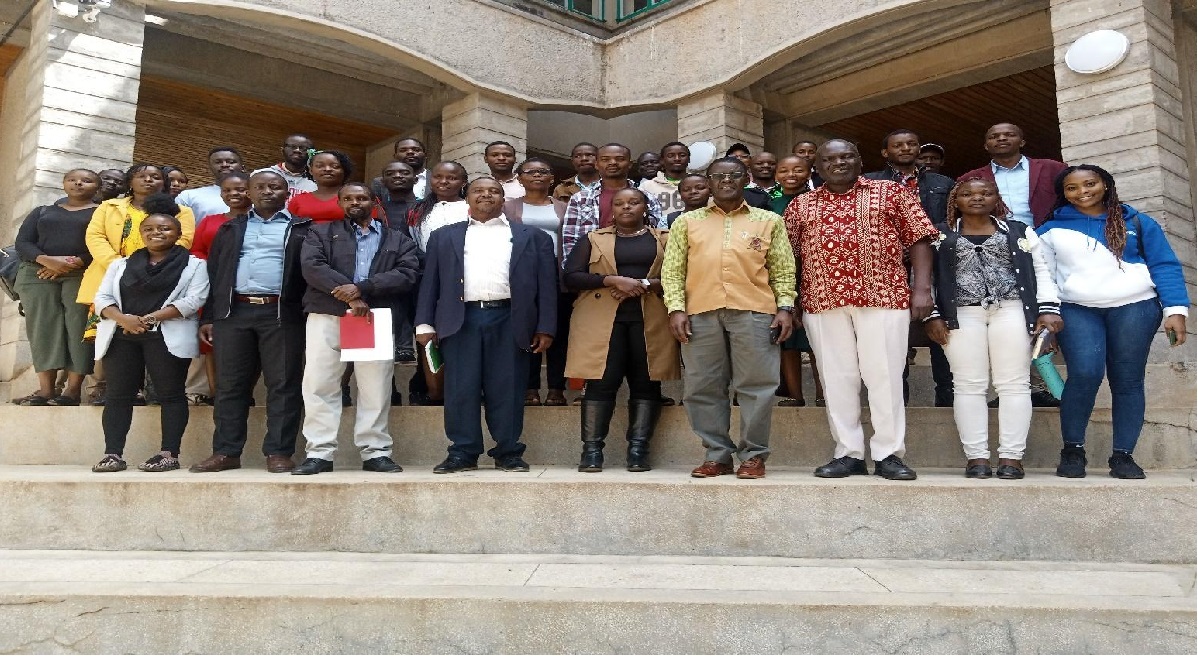
REPORT ON FACULTY OF SCIENCE POSTGRADUATE STUDENTS WORKSHOP ON THESIS/DISSERTATION PREPARATION AND EXAMINATION HELD ON 21ST MARCH, 2025 AT THE PHYSICAL SCIENCE LECTURE THEATRE 5
1.0 Preamble
The Faculty of Science has observed that postgraduate students often encounter significant challenges when developing research proposals, which are an essential part of their academic journey. Recognizing the importance of a well-structured proposal in facilitating successful research outcomes, the faculty took measures to support students in this pursuit. To address these challenges, a proposal development, thesis preparation and oral examinations workshop was organized in collaboration with the Directorate of Postgraduate Studies. The goal of this program was to give students and their supervisors the fundamental direction and abilities necessary to successfully manage the challenges of writing effective research proposals that evolve into a comprehensive thesis.
The Directorate of Postgraduate Studies and the Egerton University UNESCO Bioethics Centre honored an invitation by the Faculty of Science for a comprehensive one-day training session on March 21st, 2025. This workshop was designed to provide participants with valuable insights into various aspects of research proposal development, including ethical considerations and the processes involved in obtaining necessary permits. By focusing on these critical areas, the workshop seeks to enhance the academic experience of postgraduate students within the Faculty of Science and empower them to overcome obstacles they may face during their research journey.
The workshop was officially inaugurated by Professor Steve Oduor, the Dean of the Faculty of Science. During the opening session, he encouraged all participants to introduce themselves, fostering collaboration and engagement. Additionally, Professor Oduor introduced the esteemed guest facilitators, Professor Nyalala (Deputy Director Board of Postgraduate Studies) and Professor Ondimu (Chair, Egerton University UNESCO Bioethics Centre) whose expertise was expected to greatly enhance the workshop’s discussions and learning outcomes.
The workshop was a success with an attendance of sixty-two (62) participants. This included nineteen (19) university staff (the supervisors) and forty-three (43) postgraduate students.
2.0 Target Group
All postgraduate students and lecturers delegated the duty of supervision to postgraduate students at the Faculty of Science.
A memo was prepared and circulated to the targeted groups before the workshop day.
3.0 Program
The program was scheduled for a one-day event at the Physical Science Lecture Theatre five from 0900 hrs to 1315 hrs.
4.0 Topics Covered
- Postgraduate Research Proposal Development
- Research Proposal Challenging Issues
- Bioethics and Research Permit Acquisition
- Challenges of Permit Acquisition
- Thesis Preparation and Oral Examinations
- Challenges in Thesis Preparation and Oral Examinations
5.0 Subjects Raised and Discussed
- There is need to account for every month of the research to check on the timely completion of master`s and PhD studies.
- Proposals should be well-structured according to institutional guidelines and must demonstrate and effectively communicate the proposed research’s originality, relevance, and potential contributions to the field. Consequently, the research problem should be well defined avoiding vague or general statements.
- Participants were taken through the parts of a research proposal touching on the Egerton University required writing format and ensuring there is a connection and flow in their work which should be thorough and well-polished.
- Students were urged to avoid plagiarism, especially with the rise in use of the AI software. Additionally, they were taught on different styles of the in-text citation and use of clear methods that will allow others to cite their work.
- The mandate of the UNESCO Bioethics Centre was addressed to the participants and they outlined the guidelines to apply for ethical approval of a research project.
- Egerton University`s Institutional Review Board (IRB) stated its responsibility for reviewing research proposals to ensure ethical standards are adhered to and that participants’ rights are protected.
- Parts of a thesis using the IMRAD (Introduction, Methods, Results and Discussion) format was discussed. Sensitizing that each section should flow logically to guide readers through the research.
- The final oral presentation that a student gives to defend their thesis or research project to the panel members should be supported by appropriate data while being transparent about limitations or potential biases in your study.
- It is important to adhere to each journal`s copyright policies and guidelines regarding self-archiving and sharing one`s work online. Students should always ensure that any version they choose to share aligns with what is permissible under their agreement with the publisher.
6.0 Suggestions and Contributions
- Supervisors should be exempted from examining the thesis because of the arising conflict of interest emanating from their prior involvement in guiding the research.
- The dropout of a supervisor during research should be looked into as it poses significant challenges to the students, especially the project`s timeline.
- It is reasonable to have at least two supervisors to oversee a master`s degree student to enhance the educational experience by providing diverse expertise and reduce individual workload.
- There was a call for better communication and education about the permitting process in Kenya`s research environment after an uproar of certain places that require permissions beyond those granted by NACOSTI.
7.0 Conclusion
Based on the level of engagement of the participants, it was clear how the workshop was of importance to the Faculty of Science postgraduate students and their supervisors in developing a research proposal, learning how to acquire bioethics and research permit and preparation of a thesis and oral examination. The workshop created a positive indication of a successful postgraduate study with an expected excellent thesis journey following the Egerton University guidelines and the Kenya National Commission for Science, Technology and Innovation (NACOSTI).
8.0 Recommendations
- The board was encouraged to take advantage of the technology by creating video presentations on their website for others who might miss important workshops to access detailed information later.
- Application for the research permit from the Egerton University UNESCO Bioethics Centre should start as early as the research proposal is approved by the respective department.
- Participants were encouraged to occasionally send their suggestions to the Board of Postgraduate Studies and the Egerton University UNESCO Bioethics Centre to help in revising and enhancing more efficient services.